
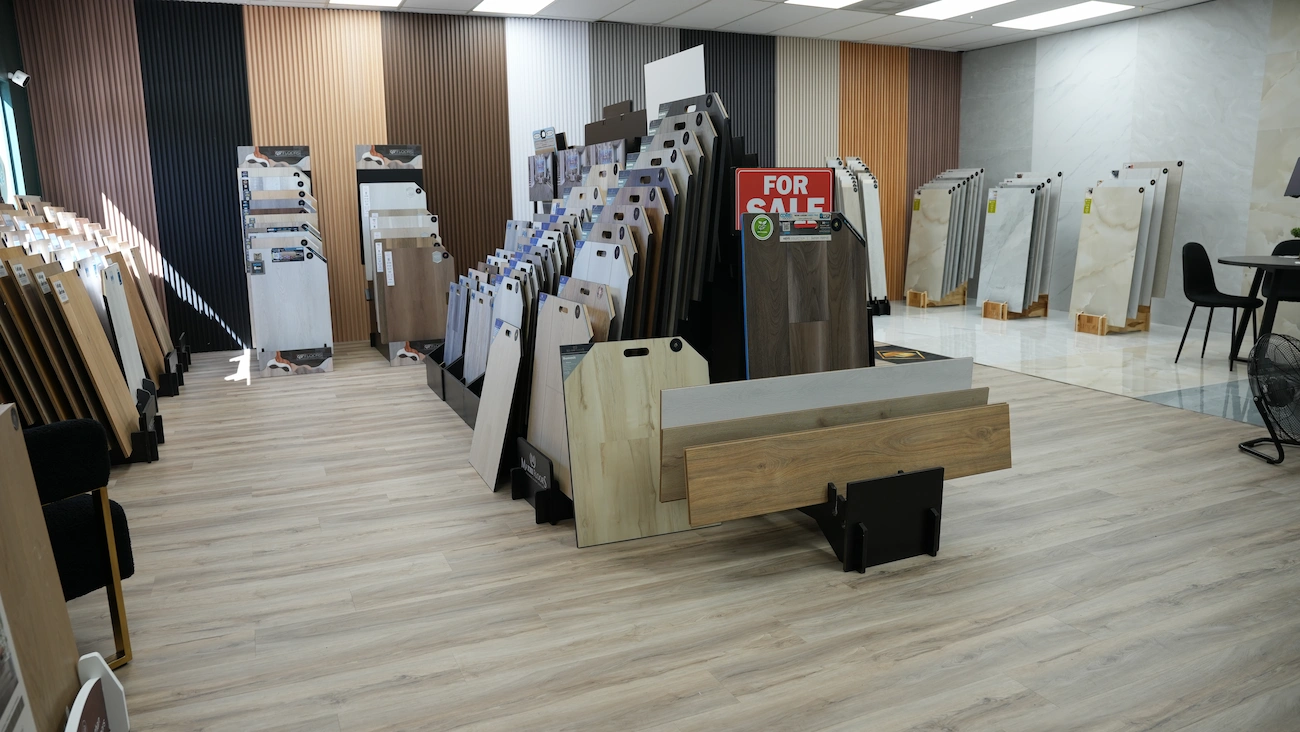
Asking what is good flooring for kitchen use assumes a kitchen is one surface with one job. It is not. The three feet in front of the sink take standing water; the strip under the bar stools takes chair legs dragged across it several times a day; and where the kitchen opens into the dining or living room, the floor has to make a decision about whether to continue or stop. Three different demands, and matching the material to each is what separates a floor that still looks right in five years from one that does not. At PSL Floor & Supply in Port St. Lucie, the same team supplies the material and installs it, with a free in-home consultation and a free estimate on every project.
Zone One: the Wet Strip, Where Good Flooring for Kitchen Use Is Decided
The area in front of the sink and dishwasher is the only part of a kitchen that regularly sees standing water rather than a wiped-up spill. It is also where most floors fail first, and it rules out anything merely water-resistant.
Two materials clear that bar. Rectified porcelain and ceramic tile at $1.79/sq ft is impervious — water simply has nowhere to go, and the rectified edge keeps grout lines thin enough that there is very little to stain. Waterproof luxury vinyl plank is waterproof through the full thickness of the plank, not sealed at the surface, which is the distinction that matters when a dishwasher line lets go overnight.
Both are honest answers: tile is harder and cooler underfoot, vinyl warmer and quieter.
Zone Two: Chairs, Traffic, and Why Wear Layer Beats Price
The second zone is wherever furniture moves — under a table, along a breakfast bar, in the walking lane between the fridge and the stove. Water is not the threat here. Abrasion is.
On vinyl this is measured in mils of wear layer, and the two collections sit at opposite ends of it. Deco54 (9″ × 54″ planks, 7mm thick, 22 mil wear layer) runs $2.19/sq ft and is built for exactly this kind of punishment. Quick48 (7″ × 48″, 5.5mm, 12 mil) is $1.79/sq ft and is the sensible choice in a kitchen where chairs sit on a rug or where the traffic is lighter.
The forty-cent difference per square foot is the entire decision, and on a typical kitchen it is smaller than it sounds — worth spending if bar stools get dragged daily. On tile, the equivalent figure is the PEI 3 abrasion rating, which covers residential kitchen traffic across all eleven porcelain collections.
Zone Three: Where the Kitchen Ends
In an open-plan house the kitchen floor does not stop at a wall, Running one material straight through reads cleaner, but that material then has to satisfy the wet zone and the living room at once.
Real hardwood is the opposite case. Engineered oak starting at $5.19/sq ft brings a warmth and a refinishing life that no vinyl matches, and it belongs on the dry side of that line — dining room, living room, hallway — rather than in front of a dishwasher. If the goal is a timber look running continuously through both, waterproof vinyl in the oak-named colors delivers it without asking wood to sit in water.
Whichever way it resolves, matching baseboard finishes the change and hides the expansion gap the installation needs.
What Good Flooring for Kitchen Projects Actually Costs
Per-square-foot pricing is published on every product, which is unusual in this trade — but it is not what a kitchen costs, because flooring sells by whole boxes and box coverage varies by material.
A 200 sq ft kitchen works out to roughly 13 boxes of porcelain tile at about 15.5 sq ft per box, 10 boxes of Deco54 at 20.19 sq ft, or 9 boxes of Quick48 at 23.97 sq ft. Always round up: partial boxes are not sold, and cuts around cabinets and islands consume more material than a rectangle suggests.
One more line item people forget. Baseboard is priced per linear foot, $0.89 to $1.10, which means it is measured on the room’s perimeter rather than its area — a 200 sq ft kitchen might only need 58 linear feet. And every published price is material only; installation is quoted per project, which is what the free estimate is for.
Seeing It in Your Own Kitchen Before You Commit
Kitchen lighting is unforgiving — undercabinet LEDs, a window and overhead fixtures all hitting the floor at once, none of which a showroom reproduces. That is the reason the in-home consultation brings full-size samples to the house rather than handing over chips at a counter, so a polished finish can be judged against the actual cabinets under the actual light.
The showroom is at 1532 SE Village Green Dr – Unit G, Port St. Lucie, FL 34953, open Monday to Friday 8:00 AM to 4:30 PM and Saturday 9:00 AM to 3:00 PM, with installation across Port St. Lucie, Stuart and Palm City. Call (772) 771-7177 or use the contact page to book. The genuinely good flooring for kitchen spaces is rarely one material chosen in a showroom — it is the right material in each of the three zones, priced honestly and installed by the people who sold it.
Frequently Asked Questions
What is the single best flooring for a kitchen?
There is no single answer, because a kitchen has three zones with different demands. In front of the sink and dishwasher you need something fully waterproof — rectified porcelain tile at $1.79/sq ft or waterproof luxury vinyl plank. Under chairs and in traffic lanes, wear layer matters more than water. Where the kitchen meets an adjoining room, the question is whether to continue the same material or transition.
Is tile or vinyl better in front of the sink?
Both work. Porcelain tile is impervious and the rectified edge keeps grout lines thin, so there is very little to stain. Waterproof vinyl is waterproof through the full plank thickness rather than sealed at the surface. Tile is harder and cooler underfoot; vinyl is warmer and quieter. The choice is comfort and budget, not performance.
What is the difference between Deco54 and Quick48?
Wear layer, mainly. Deco54 is 9″ × 54″, 7mm thick with a 22 mil wear layer at $2.19/sq ft, built for chairs dragged daily. Quick48 is 7″ × 48″, 5.5mm with a 12 mil wear layer at $1.79/sq ft, and is the sensible pick for lighter traffic. Both are fully waterproof.
Can I put hardwood in my kitchen?
Engineered hardwood starting at $5.19/sq ft belongs on the dry side of the kitchen — the dining room, living room or hallway — rather than in front of a dishwasher. If you want a continuous timber look through both spaces, waterproof vinyl in the oak-named colors gives you the appearance without putting real wood in standing water.
How do I estimate what a kitchen floor will cost?
By boxes, not square feet, since partial boxes are not sold. A 200 sq ft kitchen is roughly 13 boxes of porcelain (about 15.5 sq ft per box), 10 of Deco54 (20.19 sq ft) or 9 of Quick48 (23.97 sq ft), rounded up for cuts around cabinets. Baseboard is priced per linear foot at $0.89 to $1.10, measured on the perimeter. Every published price is material only — call (772) 771-7177 for a free installation estimate.