
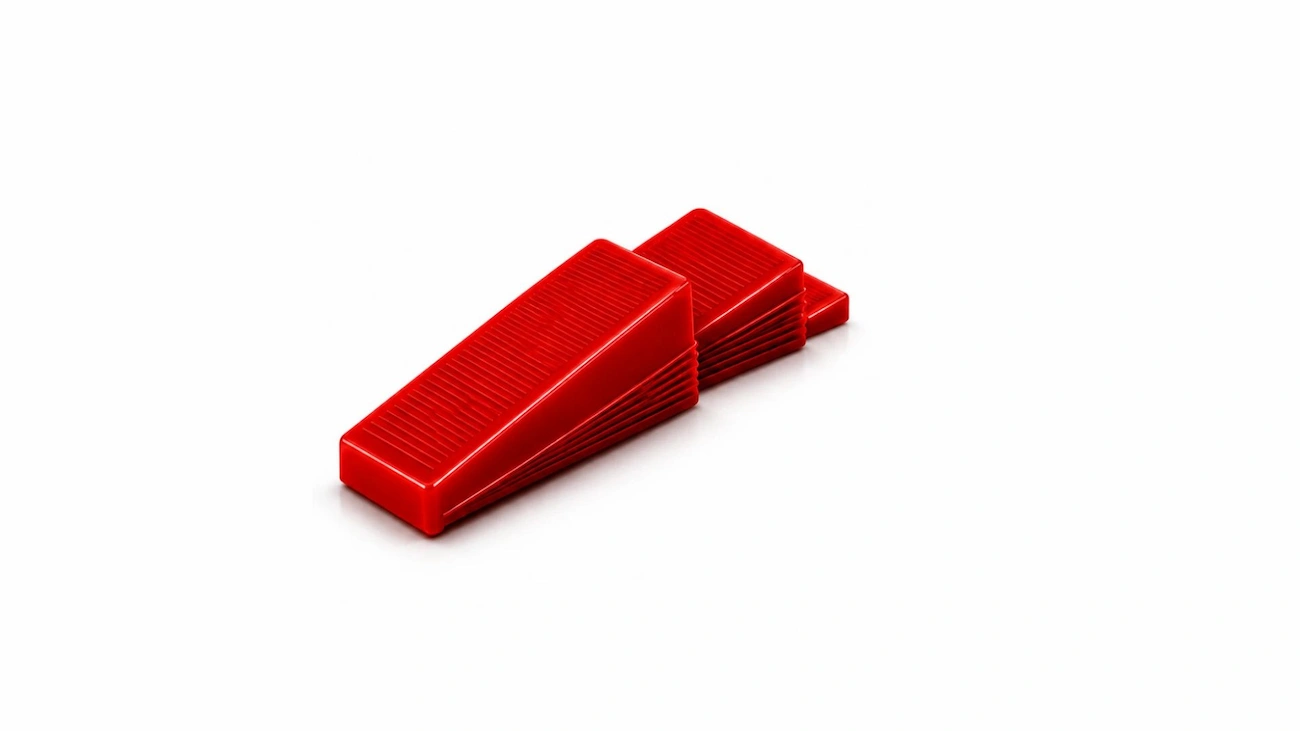
In a tile leveling system, the clip holds position — but the wedge does the work. The wedge is the component that applies and distributes the mechanical force pushing adjacent tiles to the same plane before the adhesive cures. Driving a wedge correctly produces a flat, lippage-free joint. Driving it with inconsistent pressure — or with a wedge that flexes rather than holds — produces a joint that looks right during installation and reveals its problems only after the mortar locks everything in place.
PSL Floor & Supply stocks 500 professional tile leveling wedges for $30 in Port St. Lucie, available for same-day pickup. The wedges are designed for repeated use — recoverable after each installation and reusable across tile courses and future projects. For contractors running ongoing tile work on the Treasure Coast, a wedge supply is a one-time investment rather than a per-job consumable. Combined with PSL Floor’s clip inventory (3,000 clips for $99 in 1mm or 1.5mm, bulk pricing at $89/3,000 for orders over 15,000 clips), the complete leveling system is available in-store without a shipping wait.
How Tile Leveling Wedges Work — The Mechanics of Applying Leveling Force
The wedge’s function depends on its tapered geometry. Unlike a flat shim or a spacer that simply fills a gap, a tile leveling wedge converts forward linear motion into simultaneous downward and lateral force at the joint — pulling both tiles toward the subfloor and toward each other as the wedge advances through the clip base.
The sequence: once a clip is positioned under both tile edges at a joint and the adjacent tile is set in adhesive, the wedge is inserted through the slot in the clip base with the tapered face oriented against the clip’s internal contact surface. The wedge is then driven — with a rubber mallet for manual installations or a dedicated wedge tightening tool for higher-volume work — until both tiles register at the same plane. The driving stops when the leveling resistance is correct: enough pressure to hold both tiles at the same height, not so much that the clip base or the tile edge takes stress damage.
After the mortar has fully cured — typically 24 hours for standard thin-set, though the specific adhesive product’s curing time governs — the clip tab is removed with a sharp mallet strike. The clip breaks at its scored base and is discarded. The wedge releases cleanly from the base and is collected for reuse on the next row.
Why Professional-Grade Tile Leveling Wedges Outperform Low-Cost Alternatives
The wedge’s job is to apply consistent, repeatable force across every joint on the same floor — which means the material and geometry have to perform identically at joint 1 and joint 2,000. That repeatability is what separates contractor-grade wedges from cheaper alternatives.
Wedges made from lower-quality plastic develop problems after repeated driving cycles. The tapered driving profile rounds off at the contact edge. The body develops micro-flex — a slight give when force is applied — that makes it impossible to judge when full leveling tension is reached. After enough cycles, the wedge no longer produces the same leveling force as a fresh one, which means the last section of a large tile job is not as flat as the first.
Professional wedges are manufactured to tighter tolerances and from materials that maintain their profile through extended use — the driving edge stays sharp, the body stays rigid, and the force applied at joint 500 is the same as at joint 1. For a contractor setting several hundred square feet of 24″ × 48″ rectified porcelain, that consistency is what produces a finished floor that reads flat under light from any angle. Browse PSL Floor’s full accessories catalog alongside tile and flooring materials on the products page.
Tile Leveling Wedges Are Reusable — The Contractor Cost Advantage
The division between the clip and the wedge is also the division between consumable and reusable. Clips are single-use: once the tab is struck off, the clip is done. Wedges, collected carefully after each installation, can be reused across dozens of tile courses and multiple projects — making them a fundamentally different cost category from clips.
For a contractor running regular tile installations in Port St. Lucie and across the Treasure Coast, the practical approach is to build and maintain a standard wedge inventory and restock clips as each project requires. A $30 purchase of 500 professional wedges, reused across 15 to 20 tile projects, reduces the per-project wedge cost to under $2. The clips — replenished from PSL Floor’s inventory at $99 per 3,000 or $89 per 3,000 for orders over 15,000 — are the only per-project leveling supply expense.
This structure also means that a contractor who already has a wedge supply on the truck only needs to pick up clips from PSL Floor before the next job. Both products are in stock for same-day pickup in Port St. Lucie — no minimum order, no pre-order required.
Tile Leveling Wedges for Large-Format Tile — Consistent Force Across Every Joint
The importance of consistent wedge driving increases directly with tile format size. Small tiles are more forgiving — minor variation in leveling tension at a joint produces minor lippage that is partially hidden by the tile’s proportions. A 24″ × 48″ rectified porcelain tile amplifies any inconsistency: the large flat face and precision-cut edges make height differences at the joint immediately apparent under any light source.
PSL Floor’s tile collection includes rectified 24″ × 48″ porcelain and ceramic from $1.79/sq ft — the exact format where uniform wedge tension across every joint is the difference between a floor that passes close visual inspection and one that doesn’t. Consistent wedge driving means each joint is locked at the same resistance before the mortar cures, so the finished surface reads flat from one end of the room to the other.
The same principle applies across flooring material categories. For tile installations, wedges are the professional standard. For luxury vinyl plank and hardwood flooring installations that use different leveling approaches, PSL Floor’s crew brings the same precision standard to every installation. Finish the perimeter with MDF and pine baseboard profiles from $0.89/linear ft for a complete, professional result.
Buy Tile Leveling Wedges in Port St. Lucie — PSL Floor & Supply
Tile leveling wedges — 500 professional, reusable wedges for $30 — are in stock at PSL Floor & Supply for same-day pickup on the Treasure Coast. No shipping lead time, no minimum order. Pair them with a 3,000-clip bag ($99 in 1mm or 1.5mm, bulk at $89/3,000 for orders over 15,000 clips) and the complete tile leveling system is in one stop.
The showroom is at 1532 SE Village Green Dr – Unit G, Port St. Lucie, FL 34953, open Monday through Friday from 8:00 AM to 4:30 PM and Saturday from 9:00 AM to 3:00 PM. Call (772) 771-7177, email [email protected], or use the contact page to confirm stock or set up a contractor account. For tile contractors and homeowners across Port St. Lucie, Stuart, Palm City, Fort Pierce, and Vero Beach — PSL Floor & Supply carries the tools, the tile, and the installation team under one roof.
Frequently Asked Questions
What do tile leveling wedges do in a leveling system?
Tile leveling wedges apply the mechanical force that locks adjacent tiles at the same plane while the adhesive cures. The wedge is inserted through the base of a leveling clip placed between two tiles, and as it is driven forward, its tapered profile pushes both tiles down toward the subfloor simultaneously. The result is a flat, lippage-free joint held in position until the mortar sets. PSL Floor & Supply stocks 500 professional wedges for $30 in Port St. Lucie — call (772) 771-7177 to confirm stock.
How many times can tile leveling wedges be reused?
Professional-grade tile leveling wedges can be reused across many tile courses and multiple projects — there is no fixed reuse limit as long as the wedge profile remains intact and the driving edge shows no rounding or deformation. Wedges should be inspected after each project: any wedge that has developed flex, visible wear on the driving profile, or cracking should be retired. Clips are single-use (the tab breaks off when removed); wedges are the reusable component. PSL Floor’s 500-wedge supply at $30 is designed for ongoing contractor use, not one-time disposal.
Is there a risk of overtightening tile leveling wedges?
Yes. Driving a wedge too hard puts excess stress on the clip base and can press unevenly on the tile edge — particularly on rectified porcelain where the edge tolerance is tight. The correct technique is to drive the wedge until both tiles are level and the resistance is firm, then stop. A rubber mallet with moderate strikes is the standard approach; a dedicated wedge tightening tool provides more consistent control for high-volume installations. The goal is leveling tension, not maximum mechanical force. PSL Floor’s installation crew uses this approach on every tile project — call (772) 771-7177 to ask about professional installation services.
Do tile leveling wedges work with all tile sizes?
Yes — tile leveling wedges work with any tile format that uses a compatible clip-and-wedge leveling system. They are most valuable for large-format tiles (24″ × 48″ and above) where the distance between support points makes lippage harder to control manually. For smaller tile formats, leveling clips and wedges still improve installation consistency, but the margin between a professional and non-professional result is more visible at larger formats. PSL Floor carries rectified 24″ × 48″ porcelain and ceramic from $1.79/sq ft — the format where leveling wedges are a professional standard. Visit the tile page for full specs.
Where can I buy tile leveling wedges in Port St. Lucie?
PSL Floor & Supply carries 500 professional tile leveling wedges for $30 in Port St. Lucie, available for same-day in-store pickup with no minimum order. Tile leveling clips (3,000 for $99 in 1mm or 1.5mm, bulk pricing at $89/3,000 for orders over 15,000) are also in stock. The store is at 1532 SE Village Green Dr – Unit G, Port St. Lucie, FL 34953, open Mon–Fri 8:00 AM–4:30 PM and Sat 9:00 AM–3:00 PM. Call (772) 771-7177, email [email protected], or use the contact page for contractor inquiries.